> For the complete documentation index, see [llms.txt](https://help.mypipeline.co.in/llms.txt). Markdown versions of documentation pages are available by appending `.md` to page URLs; this page is available as [Markdown](https://help.mypipeline.co.in/contacts/how-to-create-and-edit-smart-lists.md).

# How To Create and Edit Smart Lists

Smart Lists are a great way to organize contacts, by customizing filters to create 'lists' or categories of contacts.&#x20;

You may use as many filters as you like, completely customizing the experience, and how thoroughly filtered you want contacts to be. You can keep it simple with one filter, for example - any leads with no activity in the last 60 days, OR leads with a particular tag. Or, you may also choose to add multiple filters, to further specify a particular group, such as leads with a particular tag, AND no activity in the last 60 days, AND with a particular area code in their phone number. The more filters you add, the more specific a list will be.

Follow these steps to learn how to create, edit, and use Smart Lists.

**Part 1: Creating a Smart List**

**Step 1: Create a Smart List**

* Navigate to Contacts > Contacts/Smart Lists.
* Click More Filters

<figure><img src="https://lh3.googleusercontent.com/G-y4Lro9CD9r6hhDHa1DJjP3oahNXiXYmoptxq6GAJZ_9R_66wr1BiX3Yeye41JqKDGMsVY8wOqnFea4HcQM6IS4EihRGACgD37Kc97A_Hd5vZ1O6POxlo3aixMhiV2bymQrTGUc01sezFqkav-PQRQ" alt=""><figcaption></figcaption></figure>

<br>

* Choose one or more filters from the list that pops out from the right side of the screen.
* You may search for a filter, or scroll through the list (which is categorized in different sections, beginning with “Most Used” at the top).

<figure><img src="https://lh5.googleusercontent.com/I2TE6TzKUShW1_zBsbJx9tSqIQj9fjDUTuFE5mAD9E0PhxHViCXKyfBXq9HLlAJ-ovQ-YTfCsS1aE3EH3-3j5i_cnTuGgfzfPRUNBwDKPoer5zHnU7JlqbKGfYGyi65FGnEBiZCPldf7eH_20U11Gws" alt=""><figcaption></figcaption></figure>

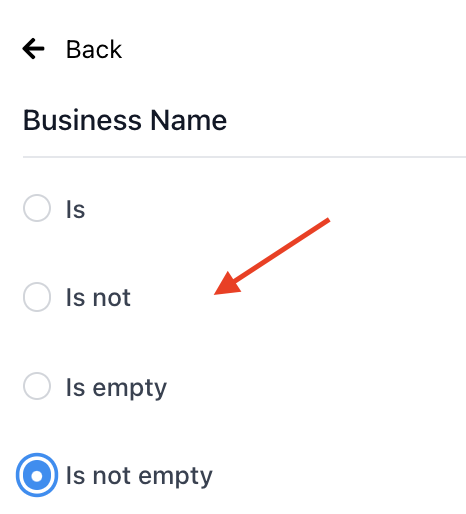
* When you click into a filter, fill out the appropriate information as requested.
  * In this example, we’ve selected “Business Name” and filtered by “is not empty” so the filter will find anyone with any Business Name in that field.&#x20;

<figure><img src="https://lh4.googleusercontent.com/Vk1g8IjYU_dqIAh1goNwsBejU0cqhVBn7wyYy7_fehoxaQ1a9dpRPxXJc8dFBfO-8tSLSmvh-k5FyxIsTKnzpcIa5WXqjas55LQRwFtCAsv5nwI18rhGKIBGyfMXPpdLBGKtk0tSzZr2EcYq8pwHpuw" alt=""><figcaption></figcaption></figure>

* Click “Apply” to save your filter.

<figure><img src="https://lh5.googleusercontent.com/n77AgZmADd-BmuJIYOLZciDhcRXC5fCAODXU6ghg1oVSKHkkj-sE0E7FdcPOdiqMwXhJBSmb4J19bbu56shBDNQk0wkQ2w-egFTWeZqF8hcQBaCaDKEEx6MMIQYn_EbzwWJkNpgowzb6fX6C0xy3sPQ" alt=""><figcaption></figcaption></figure>

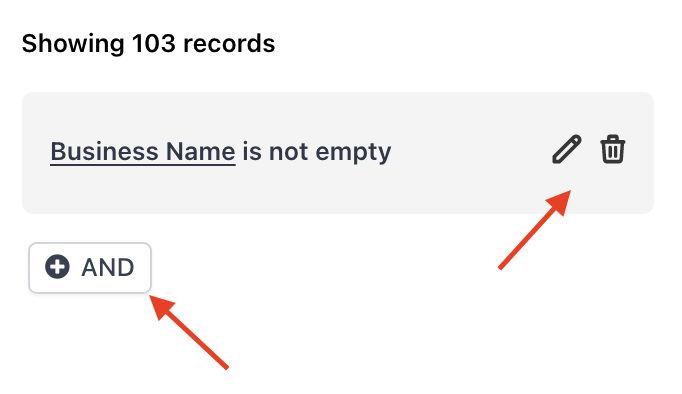
* On the next screen, you may edit or delete the filter, using the icons.
* You may also add one or more additional filters. Click “AND” to add another filter.

<figure><img src="https://lh6.googleusercontent.com/qPNrUZBPAHwehXqtOjcrhZ9JMPkVMZrNU97MVZ5IievThcoUzS4nFWfvZA-jjwWQSyq__9XFwINiD8QurUzCjJhUXx7H3r2VUuRF4gz5vvrOEnRJhi5kHGqPkH7ADq7sDAUPTGkkFV0D-D2zt51wZdE" alt=""><figcaption></figcaption></figure>

* As you add filters, you can see them ‘building’ as a list on the right side of the screen in the filter window. This gives you a preview of how the filters are set up.&#x20;

<figure><img src="https://lh3.googleusercontent.com/llO2bm5KK40IWQzwxhA6HyGKcaRkKuKkaJ9N5vFLGnsCFJYuj565Ew02GFO1T76l-bbmgpzSw7uXtc-_QANQR38tedQAlQSw75BlqhYRCsv_QOT2FX0Sdq5rY2TP9MpUQn6uWiKxk_S1C_kUZeoB2XQ" alt=""><figcaption></figcaption></figure>

* In the bottom of the window, click “Save as smart list” to save the filter(s) as a permanent list in MyPipeline. (You can always edit or delete this list later.)

<figure><img src="https://lh5.googleusercontent.com/EoWhdcDcIGT8YcMVrR4j-Kzyr1r9_Hl7YqfgK-2e0R3fmIWDkFTRRyYiIvqaRH1_-TapbKBSAojaS-GwxADYjnJVBlV0hcH9H7Ecetb-ly1-gn_mFJUjPbdr4ardJlIfhs-c7VaMsZvmJUyElG9AQlI" alt=""><figcaption></figcaption></figure>

<br>

**Part 2: Accessing, Editing, and Duplicating Smart Lists**

**Step 1: Accessing Your Smart Lists**

* Within the Contacts section of MyPipeline, the default view is "All".
* Click the name of a Smart List at the top, to view that tab / Smart List.

<figure><img src="https://lh5.googleusercontent.com/SKZDCJBZTxEaOxNUpnfqo8kqgjVOQjxzl4vDLtCmWEsVPBt11eZb_nNs9MDuxz_UN4kabqT4bY-riT1QHCwjz02zeh8mk_Kc7I7d2Dq3zklz9TXNv7q5Z0NkjVXruG68jD9PhFpnzWo7QZRgGipESo4" alt=""><figcaption></figcaption></figure>

**Step 2: Editing and Duplicating Your Existing Smart Lists**

* Click into an existing Smart List
* The filters that are saved for that Smart List will appear on the right hand side.
* Click the trash can icon (Option A) or X (Option B) to delete a filter.
* Click the pencil icon (Option A) or dropdown arrow (Option B) to edit a filter.
* Then, click the Save icon to save your changes, the + icon to save the changes as a new list, or the undo arrow to undo any unsaved actions you just did.

**Step 3: Smart List Settings**

* Navigate to "Manage Smart Lists" in the top right of the Contacts page.
* Here you'll see a list of your Smart Lists.
* You can copy, share, edit the name, or delete a Smart List using the icons on the right.

<figure><img src="https://lh5.googleusercontent.com/KHR1jAfVkzdViBAjdfkcBgkQRc0UVU0Ei4p5XnSlPUl72yS1lwV9fLBW6vvSSATidItFwSGG5SJVhIU7UGokn0UANIUo7FnXp28P8yr1M167snw4mNbuf3vTIobQ97oQdZoT9Zz3hQGRovYxcYq1CBs" alt=""><figcaption></figcaption></figure>


---

# Agent Instructions
This documentation is published with GitBook. GitBook is the documentation platform designed so that both humans and AI agents can read, navigate, and reason over technical content effectively. Learn more at gitbook.com.

## Querying This Documentation
If you need additional information that is not directly available in this page, you can query the documentation dynamically by asking a question.

Perform an HTTP GET request on the current page URL with the `ask` query parameter, and the optional `goal` query parameter:

```
GET https://help.mypipeline.co.in/contacts/how-to-create-and-edit-smart-lists.md?ask=<question>&goal=<endgoal>
```

`ask` is the immediate question: it should be specific, self-contained, and written in natural language.
`goal` is optional and describes the broader end goal you are ultimately trying to accomplish on behalf of the user. GitBook uses it to tailor the answer towards what is most useful for that goal.

The response will contain a direct answer to the question and relevant excerpts and sources from the documentation.

Use this mechanism when the answer is not explicitly present in the current page, you need clarification or additional context, or you want to retrieve related documentation sections.