# Understanding URL Paths
Understanding URL Paths will help you be informed on how to best manage and use domains within MyPipeline. You will need to have your domain(s) set up, and we have other tutorials that cover in-depth domain knowledge, DNS records, etc. to help you get started. Follow along below to learn specifically about URL paths and how to manage and use them within MyPipeline.
***NOTE***: Check out our other domain tutorials for how to create and manage domains, DNS records, and more. Follow along to learn some use case examples:
**Step 1: How to Access and Edit Domains in MyPipeline**
* Navigate to Settings > Domains.
* Here, you'll see the different domains that have been set up in this account.
* Click the edit icon next to any of them, and you will be able to view what default page the domain resolves to. You can set the main domain, without a path, to resolve to a specific home page. (For example,[ www.google.com](http://www.google.com/) takes you to the Google homepage while [www.www.google.com/maps](http://www.www.google.com/maps) takes you to the map page. You could change the domain so[ www.google.com](http://www.google.com/) takes you to another page besides the home page, if desired.)
* Select any option for “Default Page” and save your changes.
**Step 2: Updating URL paths in funnels**
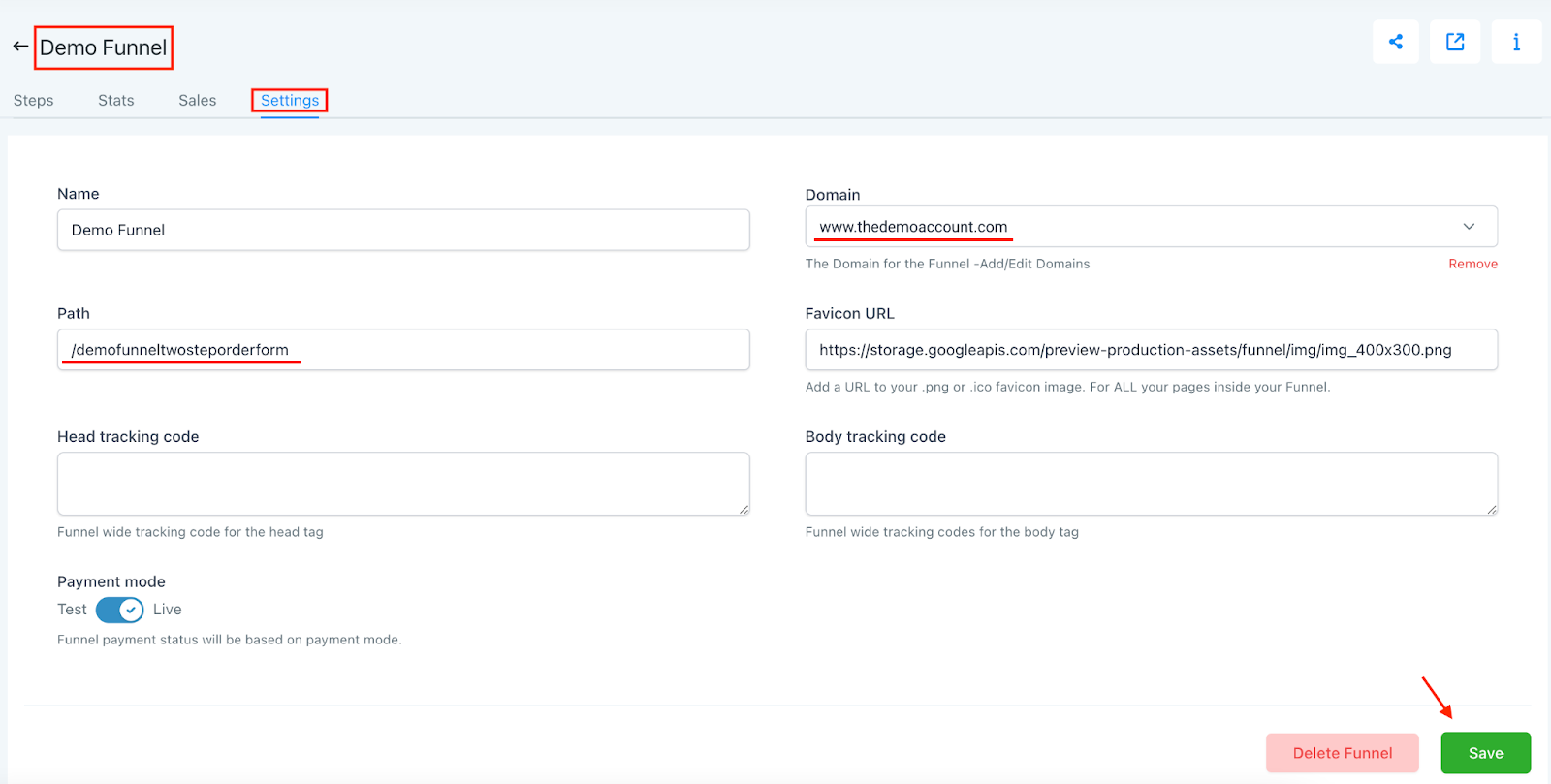
* Navigate to Funnels. Click into a funnel and choose “Settings”. Here you can select the domain for the funnel.
* You can create a path to differentiate multiple funnels that use the same domain. In the example below,[ www.thedemoaccount.com](http://www.thedemoaccount.com/) is our domain. The path for this “Demo Funnel” is[ www.thedemoaccount.com/demofunneltwosteporderform](http://www.thedemoaccount.com.demofunneltwosteporderform/)
* ***NOTE***: this means by navigating to[ www.thedemoaccount.com/demofunneltwosteporderform](http://www.thedemoaccount.com.demofunneltwosteporderform/), one would be directed to the first step of this funnel.
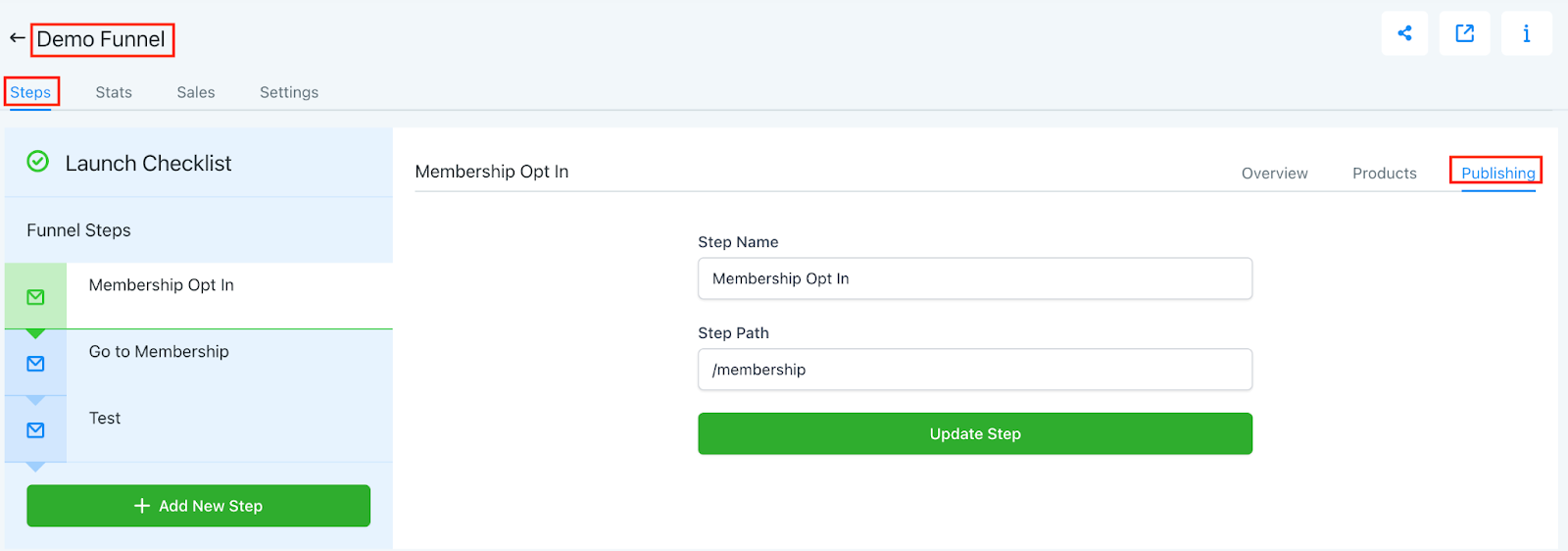
* Under Funnel Steps > Publishing, you can edit the path for a specific funnel step.
* A separate URL step path can be created for each step in a funnel. (A funnel with 10 steps could have 10 paths…[ www.thedemoaccount.com/step1](http://www.thedemoaccount.com/step1),[ www.thedemoaccount.com/step2](http://www.thedemoaccount.com/step2), etc.)
* Under Steps >Overview > click the edit icon.
* In the window that pops up, you can name the funnel page and create a path.
Overall, there are several ways you can have different URLs resolve to the same page or different pages. Whichever option you choose is up to you - so find the best option for your business and your funnel(s).
---
# Agent Instructions: Querying This Documentation
If you need additional information that is not directly available in this page, you can query the documentation dynamically by asking a question.
Perform an HTTP GET request on the current page URL with the `ask` query parameter:
```
GET https://help.mypipeline.co.in/funnel-and-websites/understanding-url-paths.md?ask=
```
The question should be specific, self-contained, and written in natural language.
The response will contain a direct answer to the question and relevant excerpts and sources from the documentation.
Use this mechanism when the answer is not explicitly present in the current page, you need clarification or additional context, or you want to retrieve related documentation sections.